COI Tracking for Roofers: Insurance Compliance Guide
Roofing is the highest-risk trade in construction. Falls, property damage, and post-installation failures make rigorous COI tracking non-negotiable. Learn what insurance roofers must carry and how to verify every certificate.
Roofing is, by every objective measure, the most dangerous trade in construction. The Bureau of Labor Statistics consistently ranks roofing among the top three occupations for fatal injury rates, and OSHA devotes an entire emphasis program to fall protection in roofing because the hazard is so persistent and so lethal. But the risk does not end with worker safety -- it extends to the buildings beneath the roof, the occupants inside, and the owners who will live with the consequences of installation errors for decades.
From an insurance and compliance perspective, roofing is classified as a Tier 3 (high-risk) trade -- a designation shared by only a handful of construction specialties. This classification is not arbitrary. It reflects decades of actuarial data showing that roofing claims, when they occur, are among the most expensive in all of construction: six-figure workers\' comp claims for fall injuries, seven-figure property damage claims for water intrusion from failed roofs, and liability claims that can extend for a decade or more under completed operations coverage.
For general contractors and property owners, the message is clear: COI tracking for roofing contractors requires a higher standard than for any other trade. This guide covers the enhanced insurance requirements for roofers, the specific coverages that must be verified on every certificate, and how to build a compliance process that matches the severity of the risk.
Why Roofers Are Tier 3 -- And What That Means for COI Tracking
Insurance carriers assign tier classifications to construction trades based on historical loss data. Tier 3 is the highest-risk category, and roofing sits firmly within it for reasons that directly impact COI verification requirements:
- Catastrophic fall exposure. Approximately 34 fatal falls per 100,000 roofing workers occur annually -- more than ten times the construction average. Non-fatal falls generate workers\' comp claims averaging over $100,000 in medical costs alone, with permanent disability cases reaching well into the seven figures. Statutory workers\' comp coverage must be verified and continuously monitored -- a single day\'s lapse while roofers are on site is an existential risk.
- Cascading property damage from roof failures. When a roof leaks, it does not just damage the roof. Water travels through wall cavities, soaks insulation, destroys ceiling finishes, shorts electrical systems, and feeds mold growth across multiple floors. A single improper flashing detail or membrane seam can result in a $500,000+ interior damage claim that manifests months or years after the roofer has left the site. This is why completed operations coverage -- and completed operations additional insured status -- is more critical for roofers than for any other trade.
- Material handling and storage risk. Roofing materials are heavy (bundles of shingles, rolls of membrane, pallets of insulation board) and are typically lifted to roof level by crane, hoist, or manual carry. A dropped bundle from elevation can kill a worker below, crush equipment, or penetrate the building envelope -- all before a single shingle is installed. General liability limits must be high enough to absorb these catastrophic single-event losses.
- Long warranty tail. Commercial roofing systems carry warranties of 10, 15, or 20+ years -- but manufacturer warranties exclude damage caused by improper installation. When a roof fails at year 8 and the manufacturer denies the warranty claim, the installing contractor\'s completed operations coverage is the only backstop. Verifying that coverage was in place at the time of installation -- and maintaining those records for the full warranty period -- is the difference between a covered loss and an uninsured building failure.
The Pain Points of Manual COI Tracking for Roofing Contractors
1. Higher-Than-Standard Limit Requirements
Most trades work with $1M/$2M general liability. Roofers need $2M/$4M -- and often a $5M umbrella on top. Manual tracking systems that treat all trades the same will miss the enhanced roofing requirements, accepting a $1M/$2M certificate that leaves $1M of uncovered exposure per occurrence. The difference between $1M and $2M in roofing claims is not theoretical -- it is the difference between a covered window replacement and an uncovered structural repair.
2. Completed Operations Verification Complexity
Roofing failures are, by a wide margin, a completed operations problem -- not an ongoing operations problem. The roofer installs the system in good weather, it passes a visual inspection, and everyone signs off. Two years later, wind-driven rain finds a gap in the flashing, and the damage begins. Verifying that the COI includes completed operations coverage, that the products-completed operations aggregate is adequate, and that CG 20 37 (completed operations additional insured) is present requires checking three separate fields on the certificate -- and manual reviewers frequently miss one or more.
3. Sub-Subcontractor and Crew Fragmentation
Roofing contractors -- especially on large commercial projects -- frequently subcontract portions of the work to specialty crews: the tear-off crew, the insulation crew, the membrane crew, the sheet metal flashing crew. Each crew may be a separate legal entity with its own insurance (or lack thereof). The GC must track COIs for every entity that sets foot on the roof, and the primary roofing contractor\'s COI may not list these sub-subs. Without a system to track the full roofing supply chain, gaps multiply at every tier.
4. Workers\' Comp Fraud and Misclassification
Roofing has a well-documented problem with workers\' comp fraud: contractors who misclassify roofers as lower-risk job titles to reduce premiums, or who pay premiums for three months and then cancel while presenting the original 12-month certificate. Both scenarios leave workers uncovered and the GC exposed. Manual COI tracking that relies solely on the certificate dates provides no defense against misclassification or mid-term cancellation -- you are checking a document that may have been invalid for months.
5. Long-Duration Claims and Record Retention
A roof installed in 2024 may fail in 2032. The roofer\'s insurance carrier in 2032 will be different from the carrier in 2024, and the 2024 carrier will require proof that the policy was active, that completed operations coverage was included, and that the GC was named as additional insured. If those records are stored in a spreadsheet on a former employee\'s laptop or in a filing cabinet that was purged during an office move, the claim will be denied. COI tracking systems must retain complete, searchable records for the full warranty period -- 10, 15, or 20 years.
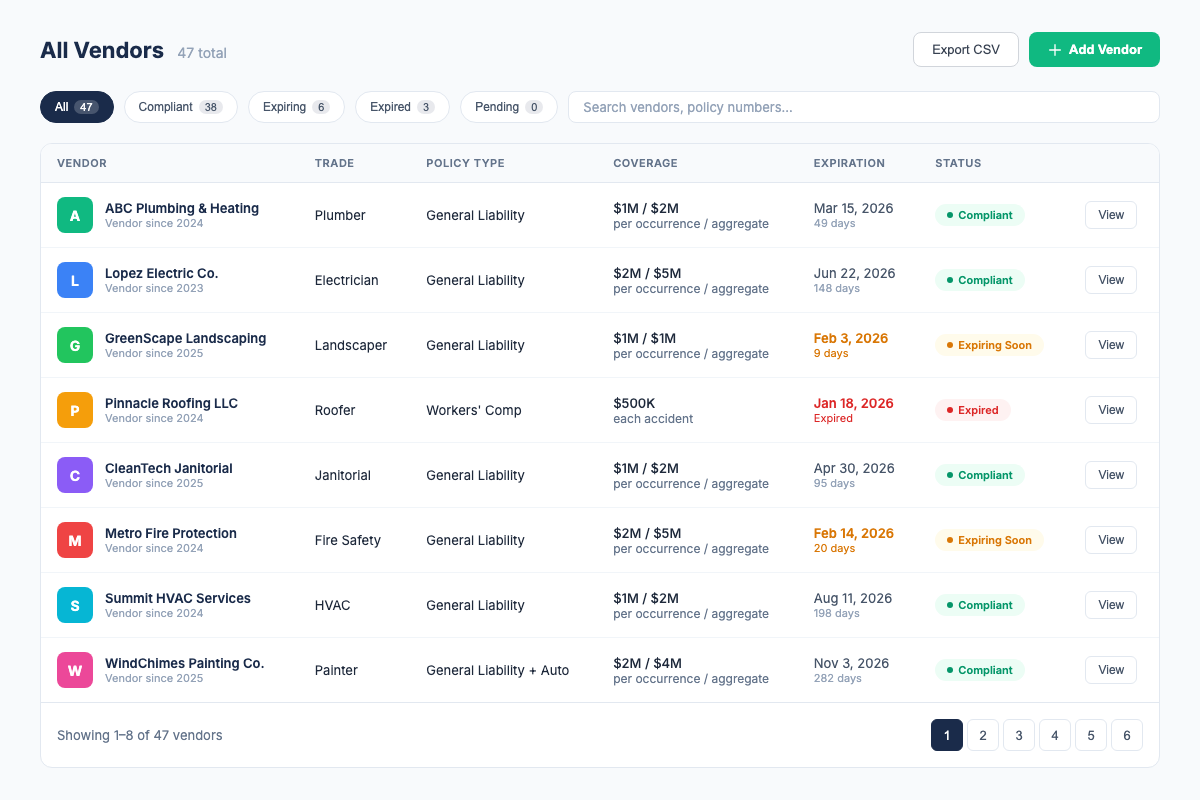
How COI Tracking Software Solves Roofing Compliance
Purpose-built COI tracking designed for high-risk trades addresses the unique severity of roofing exposure:
1. Tier 3 Requirement Templates
Define roofing-specific coverage requirements that reflect Tier 3 risk: $2M/$4M general liability (or higher per project), $5M umbrella, completed operations additional insured (CG 20 37), and statutory workers\' comp. The software automatically checks every roofing certificate against these enhanced thresholds and flags any that fall short -- even if the certificate would be compliant for a Tier 1 trade.
2. Completed Operations and CG 20 37 Verification
The software separately verifies the products-completed operations aggregate limit and the presence of CG 20 37 endorsement wording on the certificate. These are the two most critical checks for roofing -- and the two most frequently missed in manual reviews. The platform ensures both are present and adequate before the roofer is cleared to begin work.
3. Workers\' Comp Continuous Monitoring
Beyond checking policy dates on the COI, the platform sends reverification alerts at 90-day intervals for high-risk trades like roofing. If the roofer\'s workers\' comp policy was canceled mid-term, the system catches it within the quarter -- not nine months later when a serious injury reveals the gap. Integration with state verification databases adds an independent check on active policy status.
4. Sub-Crew and Sub-Sub Tracking
Roofing projects often involve multiple crews from different entities. COI tracking software lets you require certificates from every crew -- tear-off, insulation, membrane, sheet metal -- and tracks compliance for each one. The primary roofing contractor\'s COI covers their direct employees; the sub-crew certificates cover everyone else. The system ensures no one works on the roof without verified coverage.
5. Long-Term Record Archiving
Every roofing certificate, verification result, and status change is stored permanently with immutable timestamps. You can retrieve the complete compliance record for a roof installed in 2024 when a claim arises in 2032 -- including the specific policy limits, the completed operations endorsement, the additional insured status, and every alert and verification that occurred during the project. This is the difference between a covered claim and a denied one when long-tail roofing failures surface.
What to Look for in Roofing COI Tracking Software
- Tier-based requirement templates. The platform must support different coverage requirements for different risk tiers. Tier 3 (roofing) should default to higher limits -- $2M/$4M GL, $5M umbrella -- than Tier 1 trades.
- Completed operations and CG 20 37 detection. The software must separately verify the products-completed operations aggregate AND the CG 20 37 endorsement presence. Both are non-negotiable for roofing.
- Workers\' comp reverification cadence. For high-risk trades, the system should reverify workers\' comp status at 90-day intervals (or at user-defined frequencies) rather than relying solely on initial certificate review.
- Multi-entity subcrew management. Ability to request, track, and verify certificates from every roofing sub-crew -- not just the primary contractor -- in a single project dashboard.
- Umbrella/excess coverage verification. The platform must track and verify umbrella policies separately from primary GL, including the follow-form provisions that determine whether the umbrella covers the same scope as the primary policy.
- AI extraction with roofing-specific fields. The AI must correctly extract completed operations aggregate, CG 20 37 endorsement language, umbrella limits, and workers\' comp effective dates from roofing certificates in any format.
- Permanent record archiving. Roofing claims arise 5-15+ years after installation. The archive must retain complete compliance records for the full warranty period without compression, deletion, or degradation.
- Automatic alerts with enhanced urgency. 30/14/7-day alerts for roofing COIs, with the 7-day alert flagged as critical. A lapsed roofing policy is a stop-work event -- not a follow-up reminder.
COI Tracking Best Practices for Roofing Contractors
- Apply Tier 3 limits as the default -- not the exception. Never accept $1M/$2M general liability from a roofing contractor on a commercial project. $2M/$4M GL is the baseline. Add $5M umbrella for projects involving occupied buildings, schools, hospitals, or any structure where a roof failure would cause business interruption.
- Verify CG 20 37 on every roofing certificate -- no exceptions. If the roofer\'s COI does not include completed operations additional insured endorsement, do not allow work to begin. This is the single most important line on a roofing certificate.
- Reverify workers\' comp every 90 days. Do not rely on the initial COI for the full project duration. Require updated workers\' comp certificates quarterly and cross-check with state verification databases. This closes the mid-term cancellation fraud window.
- Require COIs from every sub-crew. Make it a condition of the roofing contract that the primary contractor must provide verified COIs for every sub-crew (tear-off, insulation, membrane, sheet metal) before those crews begin work. Enforce this through your COI tracking platform.
- Verify umbrella follow-form provisions. Not all umbrella policies extend completed operations coverage or additional insured status automatically. Check the umbrella carrier and policy form to confirm that the umbrella follows the same coverage scope as the primary GL policy.
- Conduct mid-project site inspections with COI verification. At least once mid-project, physically verify that the roofing crews on site match the entities listed on the COIs you have on file. Unlisted sub-subs are a common source of coverage gaps that only site presence reveals.
- Archive roofing COI records for the full warranty period plus five years. A 15-year roof warranty means 20-year record retention. Your COI tracking system must maintain complete, searchable archives for the entire period.
How COI File Helps You Track Roofer COIs
COI File was built for high-risk trade compliance. Here\'s how it handles roofing -- the highest-risk trade of all:
- Review an ACORD 25 PDF. Submit a roofer\'s PDF and review AI-assisted surfaced policy types, limits, dates, additional insured details, and endorsements.
- Keep project context. Use property or project tagging and review the requirements that apply to the work.
- Find coverage gaps. Use the review workflow to identify missing or insufficient coverage details and endorsements before approval.
- Use a vendor magic link. Request an updated PDF through a secure link without requiring the roofer to create an account.
- Stay ahead of expiration. Automatic alerts run at 30, 14, and 7 days before a vendor certificate expires.
- Export current status. Download the vendor roster as CSV for internal follow-up or sharing.
COI File starts with a 7-day trial after secure checkout and payment-method setup. Base starts at $39/month for up to 10 vendors. Start a Base trial.
Frequently Asked Questions
Industry Sources
- National Roofing Contractors Association (NRCA) -- Industry standards, safety programs, and risk management guidance for roofing contractors. nrca.net
- OSHA Fall Protection in Construction -- Federal safety standards for roofing fall protection, including Subpart M regulations and compliance assistance. osha.gov/fall-protection
- National Institute for Occupational Safety and Health (NIOSH) -- Research and data on construction fall fatalities, including roofing-specific injury statistics. cdc.gov/niosh/construction
Related Resources
- COI Tracking: The Complete Guide -- the full pillar page covering all aspects of COI tracking
- COI Tracking for General Contractors -- how GCs manage subcontractor compliance across trades
- COI Tracking for Electricians -- insurance requirements for electrical contractors
- COI Tracking for Plumbers -- completed operations and water damage coverage for plumbing contractors
- COI Tracking for Commercial Real Estate -- tenant and vendor compliance across property portfolios
- COI File Pricing -- transparent pricing, 7-day free trial on all plans
Firdaosh Bano
COI Compliance Specialist
Firdaosh Bano is a COI compliance specialist and the founder of COI File. She spent 6 years managing vendor compliance for commercial properties - tracking 2,000+ COIs across 150+ properties in spreadsheets before building the tool she wished she'd had. She writes about certificate of insurance compliance, vendor risk management, and making insurance tracking less painful for small teams.