COI Tracking for Plumbers: Insurance Compliance Guide
A single plumbing failure can cause $50,000+ in water damage weeks after the job is done. Learn what insurance plumbers need, why completed operations coverage is critical, and how to track plumbing contractor COIs.
Water damage is the most common and financially devastating property insurance claim in the United States -- and plumbing contractors are at the center of that statistic. According to industry data, the average water damage claim from a plumbing failure exceeds $50,000, and in multifamily or commercial buildings where a single failed fitting can flood multiple floors, claims routinely surpass $250,000.
What makes plumbing liability uniquely dangerous for GCs and property managers is the delay between cause and effect. A plumber installs a water supply line on Tuesday, the system is pressure-tested and passes inspection on Wednesday, and the building is occupied on Friday. Six months later, a poorly crimped connection separates behind a finished wall, and by the time anyone notices, the damage has spread across three units. At that point, the question is not whether the plumber\'s insurance covers it -- it is whether you verified that coverage was in place and adequate when the work was performed.
This guide covers the insurance requirements for plumbing contractors, why COI tracking for plumbers requires special attention to completed operations and water damage exclusions, and how to build a verification process that protects your projects from the long-tail liability of plumbing failures.
Why Plumbing Contractor COI Tracking Requires Special Attention
Plumbing is not the highest-fatality trade in construction, but it is arguably the highest-property-damage trade. The combination of pressurized water systems, concealed installations, and long latency between installation and failure creates a unique COI tracking challenge:
- Delayed failure is the norm. Unlike an electrical fault that trips a breaker immediately, or a structural failure that manifests under load during construction, plumbing failures are stealth events. A slow drip behind a wall can go undetected for months until mold blooms through the drywall. The lag between the plumber\'s work and the damage means the plumber may have changed insurers or let coverage lapse -- making your historical COI records the only proof that coverage existed at the time of the work.
- Water migration multiplies damage. A single failed fitting can affect multiple units, common areas, and even adjacent buildings. In a high-rise, water travels down through floors, damaging ceilings, walls, flooring, electrical systems, and personal property on every level it passes. These multi-floor claims can reach seven figures, which is why many projects require plumbers to carry higher-than-standard general liability limits.
- Mold and remediation costs. Modern water damage claims are not just about replacing drywall and carpet. They involve industrial drying equipment, mold remediation, air quality testing, and temporary relocation of occupants. These costs often exceed the direct repair costs by a factor of two or three. Standard general liability policies may exclude or limit mold coverage, creating a gap that must be identified during COI review.
- Finished-space exposure. Electricians and HVAC contractors often work in unfinished spaces during rough-in. Plumbers do too -- but they also perform final connections in fully finished, occupied, and furnished spaces. A fitting that leaks during commissioning can destroy flooring, cabinets, and furniture instantly -- damage that occurs during active work and falls under ongoing operations coverage, not completed operations.
The Pain Points of Manual COI Tracking for Plumbers
1. Completed Operations Coverage Gaps
The single most dangerous oversight in plumbing COI verification is accepting a certificate that shows general liability coverage but does not include products-completed operations coverage. A standard occurrence policy without completed operations might cover a plumber dropping a wrench on a finished floor, but it will not cover a pipe that bursts six months after installation. Manual reviewers frequently miss this distinction because they are checking for coverage limits -- not coverage scope.
2. Water Damage Exclusion Traps
Some plumbing contractors -- particularly those with prior claims -- may have water damage exclusions or sublimits on their policies. These endorsements can cap water damage payouts at $100,000 or $250,000 even if the general liability limit is $2 million. COIs typically show only the policy limit, not endorsements or exclusions. Without digging into the policy itself (or using COI tracking software that flags common exclusion language), these traps go undetected.
3. Claims-Made vs. Occurrence Confusion
An increasing number of plumbing contractors are being pushed into claims-made policies by insurers trying to limit their long-tail exposure. A claims-made policy only covers claims filed while the policy is active, which is fundamentally inadequate for plumbing work where failures take months to surface. Verifying that the plumber carries an occurrence-based policy -- not claims-made -- is a critical check that manual processes often skip.
4. Multi-Tier Subcontracting Gaps
On large commercial projects, the plumbing contractor listed on the subcontract may sub out portions of the work to specialty plumbers -- medical gas installers, fire sprinkler fitters, backflow prevention specialists. Each of these sub-subs needs a verified COI, but the GC rarely has direct visibility into these relationships. Without a system to track sub-subs, gaps multiply at every tier.
5. Historical COI Record Gaps
Because plumbing claims arise months or years after project completion, you need to be able to prove what coverage the plumber had at the time the work was done. Spreadsheets get corrupted, emails get deleted, and paper files get lost. A COI tracking system that maintains a permanent, timestamped record of every certificate and verification is essential for defending against delayed claims.
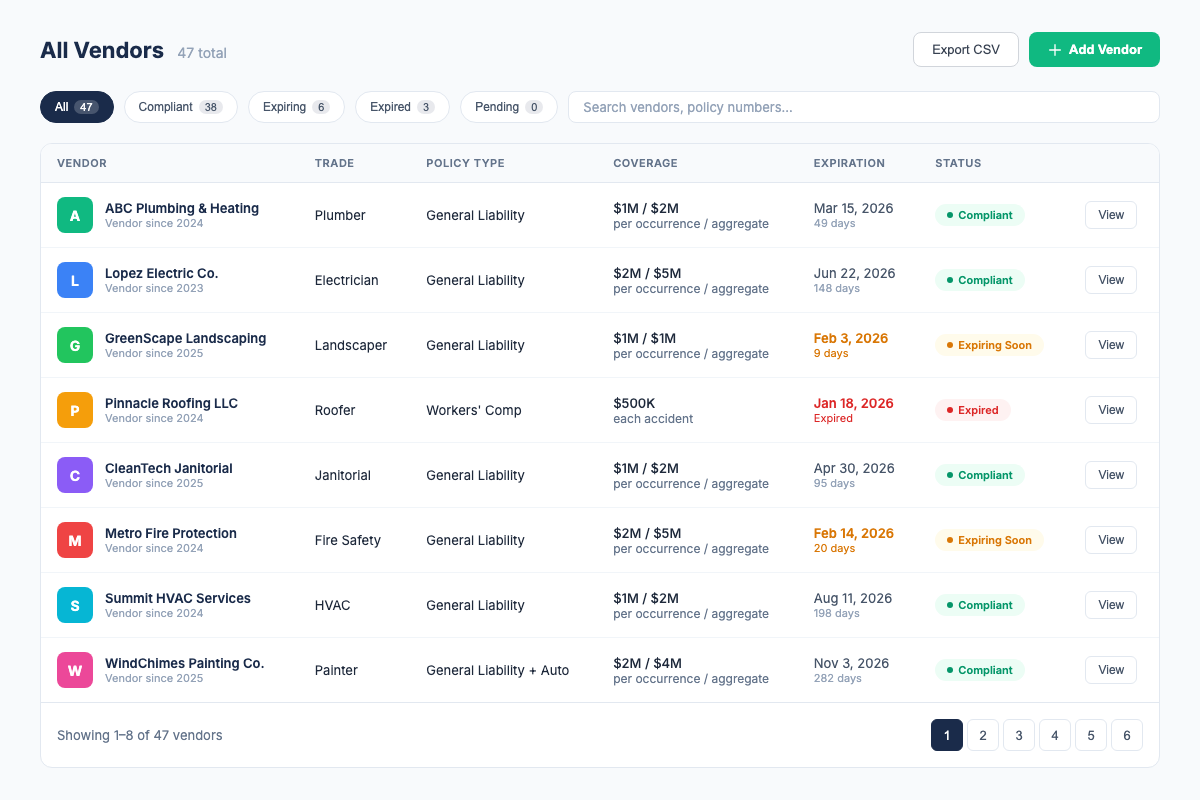
How COI Tracking Software Solves Plumbing Compliance
Purpose-built COI tracking addresses each of the unique plumbing verification challenges:
1. Completed Operations Detection
The software reads the products-completed operations aggregate limit on every certificate and flags any COI where this coverage is missing or below the required threshold. This single feature prevents the most common plumbing insurance gap: coverage that looks adequate on its face but does not actually cover the failures that are most likely to occur.
2. Policy Type Verification
COI tracking software can distinguish between occurrence and claims-made policy types by reading the policy form codes on the certificate (ISO CG 00 01 for occurrence vs. CG 00 02 for claims-made). If a plumber submits a COI on a claims-made form, the system flags it immediately -- because claims-made policies are inappropriate for trades with long-tail completed operations exposure.
3. Historical Record Maintenance
Every certificate, verification result, and status change is stored with a permanent timestamp and immutable audit log. If a water damage claim arises two years after the plumber completed the work, you can produce the exact certificate that was in force, the verification results showing completed operations coverage was adequate, and the additional insured endorsements that named your entity. This is the difference between a covered claim and a denied one.
4. Tiered Requirement Templates
Define different requirements for different types of plumbing work: residential service ($1M/$2M GL), commercial new construction ($2M/$4M GL with completed operations), and high-exposure work like hospital or high-rise plumbing ($2M/$4M GL plus umbrella). Each certificate is automatically matched against the appropriate template based on the project tag.
5. Sub-Subcontractor Cascade Tracking
When the primary plumbing contractor identifies sub-subs on their COI or in project documentation, the platform generates certificate requests for each sub-sub and tracks compliance for the entire plumbing supply chain -- all in one dashboard, all with the same verification rigor.
What to Look for in Plumbing COI Tracking Software
- Completed operations verification. The platform must detect and verify the products-completed operations aggregate limit separately from the general aggregate. This is the single most important feature for plumbing contractor tracking.
- Occurrence vs. claims-made detection. The software must identify claims-made policies and flag them as non-compliant for plumbing contractors. Occurrence-based coverage is non-negotiable for plumbing work.
- Endorsement and exclusion scanning. The platform should flag common plumbing-adjacent exclusions: water damage sublimits, mold exclusions, fungi and bacteria exclusions, and property damage to completed work exclusions.
- Tiered requirement templates. Ability to create different requirement tiers for different plumbing scopes -- because a residential service plumber does not need the same limits as a commercial high-rise plumber.
- Permanent audit trail. Immutable, timestamped records of every certificate, verification, and status change. Essential for defending claims that arise months or years after project completion.
- AI extraction with COI format support. Plumbers submit certificates in various formats -- ACORD 25, PDF from online portals, smartphone photos. The software must extract policy types, limits, dates, and additional insured status from all formats in under 30 seconds.
- Sub-subcontractor management. Ability to request and track certificates from specialty plumbing sub-subs without creating separate workflows or manual spreadsheets.
- Automatic expiration alerts. 30/14/7-day alerts to both the GC and the plumbing contractor. A lapsed plumber\'s policy is a catastrophic exposure that must be caught before it happens.
COI Tracking Best Practices for Plumbing Contractors
- Verify completed operations on every plumbing COI -- no exceptions. A general liability certificate without completed operations coverage is not acceptable for any plumbing contractor, regardless of project size or scope.
- Require occurrence-based policies only. Reject any claims-made policy from a plumbing contractor. The long latency between plumbing installation and failure makes claims-made coverage fundamentally inadequate for this trade.
- Set higher GL limits for water-exposed projects. For high-rise, multifamily, hospital, or any project where a plumbing failure could affect multiple units or critical operations, require $2M/$4M general liability at minimum -- and consider requiring umbrella coverage of $5M or more.
- Require CG 20 10 and CG 20 37 additional insured endorsements. CG 20 10 covers your entity during active construction. CG 20 37 covers your entity for completed operations claims. Both are essential for plumbing work. Verify they appear on every certificate.
- Check for water damage exclusions and sublimits. Look beyond the coverage limits on the certificate. Request a copy of the policy declarations page if the COI description of operations section mentions any water damage, mold, or fungi exclusions or sublimits.
- Track sub-subcontractor certificates from day one. Any plumbing sub-sub that touches pressurized water lines needs verified coverage. Make sub-sub COI submission a condition of the primary plumbing contractor\'s subcontract and enforce it through your tracking platform.
- Maintain COI records for at least the statute of repose in your state. In many states, construction defect claims can be filed 6-10 years after project completion. Your COI tracking system must maintain complete, searchable records for that entire period.
How COI File Helps You Track Plumber COIs
COI File was built by a compliance specialist who understands the unique long-tail liability exposure of plumbing work. Here\'s how it works for tracking plumbing contractors:
- Review an ACORD 25 PDF. Submit a plumber\'s PDF and review AI-assisted surfaced policy types, coverage limits, dates, additional insured details, and endorsements.
- Keep project context. Use property or project tagging and review the requirements that apply to the work.
- Find gaps before approval. Use the review workflow to identify missing or insufficient coverage details and endorsements.
- Use a vendor magic link. Request an updated PDF through a secure link without requiring the plumber to create an account.
- Stay ahead of expiration. Automatic alerts run at 30, 14, and 7 days before coverage expires.
- Export current status. Download the vendor roster as CSV for internal follow-up or sharing.
COI File starts with a 7-day trial after secure checkout and payment-method setup. Base starts at $39/month for up to 10 vendors. Start a Base trial.
Frequently Asked Questions
Industry Sources
- Plumbing-Heating-Cooling Contractors Association (PHCC) -- Industry standards, safety programs, and risk management resources for plumbing contractors. phccweb.org
- International Association of Plumbing and Mechanical Officials (IAPMO) -- Uniform Plumbing Code standards and plumbing system compliance resources. iapmo.org
- Insurance Services Office (ISO) -- Standard policy forms and classification codes for contractor insurance, including CG 00 01 (occurrence) and CG 00 02 (claims-made). verisk.com/insurance
Related Resources
- COI Tracking: The Complete Guide -- the full pillar page covering all aspects of COI tracking
- COI Tracking for General Contractors -- how GCs manage subcontractor compliance across trades
- COI Tracking for Electricians -- insurance requirements for electrical contractors
- COI Tracking for HVAC Contractors -- multi-coverage requirements for HVAC compliance
- Best COI Tracking Software -- compare features, pricing, and which tool fits your needs
- COI File Pricing -- transparent pricing, 7-day free trial on all plans
Firdaosh Bano
COI Compliance Specialist
Firdaosh Bano is a COI compliance specialist and the founder of COI File. She spent 6 years managing vendor compliance for commercial properties - tracking 2,000+ COIs across 150+ properties in spreadsheets before building the tool she wished she'd had. She writes about certificate of insurance compliance, vendor risk management, and making insurance tracking less painful for small teams.