COI Tracking for HVAC Contractors: Insurance Compliance Guide
HVAC contractors work with electricity, gas lines, refrigerants, and heavy equipment -- often in occupied buildings. Learn the multi-coverage insurance requirements and how to track HVAC contractor compliance.
HVAC contractors operate at the intersection of multiple construction disciplines -- electrical, plumbing, gas fitting, and mechanical engineering -- making their insurance requirements more complex than virtually any other trade on a commercial project. A single HVAC contractor may simultaneously be installing 480V electrical disconnects, brazing copper refrigerant lines under pressure, connecting natural gas supplies to rooftop units, and programming building automation control sequences. Each of those activities carries a different insurance exposure that a single general liability policy may not fully address.
For general contractors and property managers, the multi-discipline nature of HVAC work means COI tracking must go beyond the standard general liability and workers\' comp verification. Professional liability, pollution coverage, and completed operations endorsements all become critical checkpoints -- and each one represents a potential coverage gap if not verified and tracked systematically.
This guide covers the full insurance requirements for HVAC contractors, why this trade demands a multi-coverage verification approach, and how COI tracking software handles the complexity of HVAC compliance management across projects.
Why HVAC Contractors Have the Most Complex COI Requirements
HVAC contractors are unique among construction trades because their work spans both physical installation and professional services. This dual nature creates a COI verification burden that no other trade fully shares:
- Four mandatory coverages, not two. Most trades require general liability and workers\' comp. HVAC contractors also need auto liability (they transport heavy equipment, refrigerants, and sheet metal in commercial vehicles) and professional liability (system design errors, load calculation mistakes, equipment mis-specification are professional service failures -- not general liability events). That is four separate policies or coverage parts to verify on every certificate.
- Multi-hazard worksite exposure. HVAC technicians work with high-voltage electricity, natural gas, pressurized refrigerants, rotating machinery, and elevated work platforms -- often simultaneously, and often inside fully occupied buildings. An incident involving any one of these hazards can trigger claims under multiple coverage types, which means all coverages must be active and adequate at the same time.
- Occupied building risk. Unlike framers or drywallers who work primarily during new construction, HVAC contractors frequently perform installations and retrofits in occupied commercial buildings, hospitals, schools, and apartment complexes. The presence of tenants, patients, or students during HVAC work dramatically increases the liability exposure for property damage, bodily injury, and business interruption.
- Long-equipment-life liability tail. A commercial HVAC system has a design life of 15-25 years. An installation error -- a misaligned compressor, an undersized duct, a refrigerant charge error -- may not cause a failure for 5-10 years, but when it does, the resulting claim (equipment replacement, business interruption, energy overcharges) can reach six or seven figures. Completed operations and professional liability coverage must be verified and maintained for the full liability tail.
The Pain Points of Manual COI Tracking for HVAC Contractors
1. Four-Policy Verification Overload
Manual COI reviews for HVAC contractors require checking four separate coverage types -- general liability, workers\' comp, auto liability, and professional liability -- each with its own limits, effective dates, and carrier information. A single-page ACORD 25 form crams all of this into small boxes. It is easy to miss a lapsed professional liability policy or an auto liability limit that is below the $1M CSL requirement. This is the most common source of HVAC compliance gaps: coverage that exists but is not verified.
2. Professional Liability Complexity
Professional liability (errors and omissions) is the coverage that most manual COI reviewers are least familiar with -- and it is the coverage most likely to be missing or inadequate on an HVAC contractor\'s certificate. Unlike general liability, professional liability is often written on a claims-made basis, not occurrence. This means the policy must be active both when the work was performed and when the claim is filed. If an HVAC contractor lets their professional liability lapse between projects, a claim for design errors on a prior project may have no coverage.
3. Refrigerant and Environmental Exposure
HVAC contractors handle refrigerants regulated under EPA Section 608, including R-410A, R-134a, and legacy refrigerants like R-22. An accidental release during installation or service can trigger environmental reporting requirements, cleanup costs, and third-party claims. Standard general liability policies often exclude pollution-related events. Verifying that the HVAC contractor carries either pollution liability coverage or a specific refrigerant release endorsement is a step that manual COI tracking rarely includes -- but the exposure is real and growing as refrigerant regulations tighten.
4. Gas Line and Combustion Risks
Many HVAC systems -- furnaces, boilers, rooftop units -- connect to natural gas or propane lines. A gas leak caused by improper connection or failed pressure testing can result in fire, explosion, or carbon monoxide exposure. These claims fall under general liability, but they require completed operations coverage because gas leaks at mechanical joints often develop weeks or months after installation as fittings settle and temperature cycles stress connections.
5. OEM Warranty and Insurance Interaction
HVAC equipment manufacturers provide warranties -- but those warranties typically exclude damage caused by improper installation. When a $50,000 chiller fails due to a refrigerant piping error, the manufacturer denies the warranty claim, and the loss falls on the installing contractor. If the contractor\'s general liability or professional liability is inadequate or lapsed, the GC and owner absorb the loss. COI tracking that verifies coverage adequacy and continuity protects you from warranty-denial scenarios.
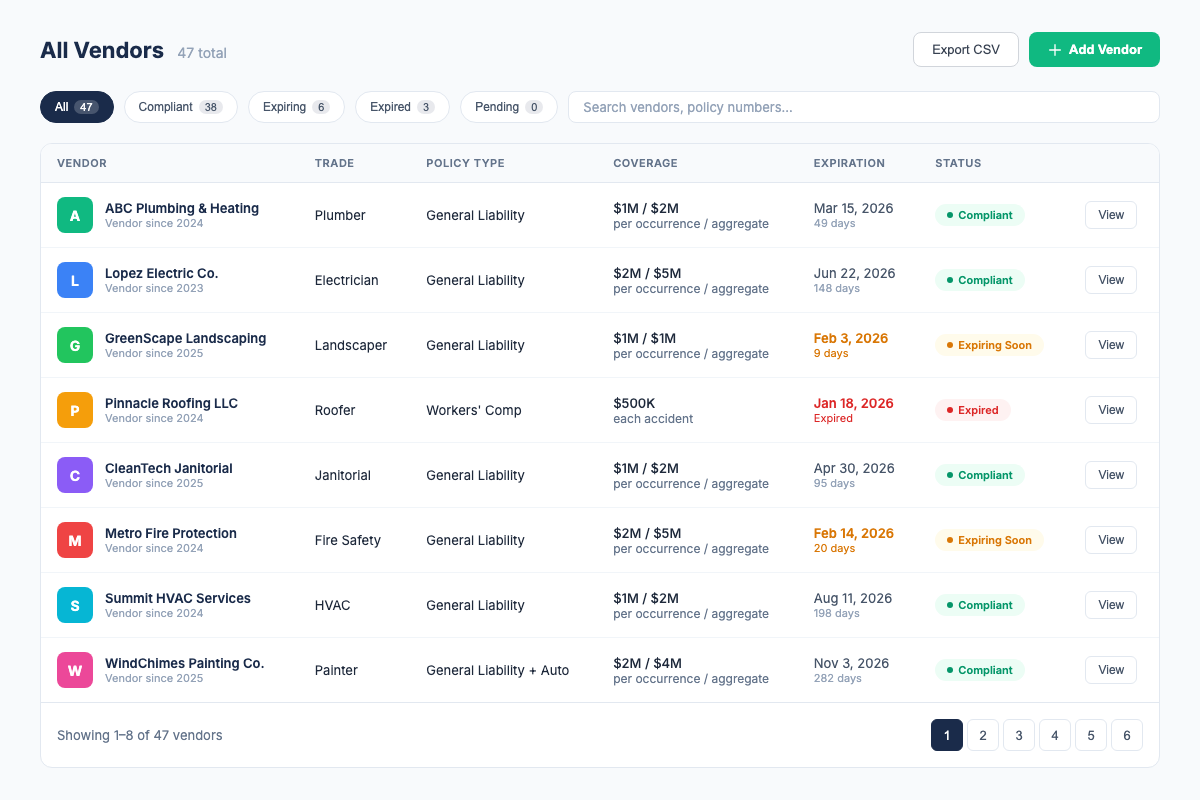
How COI Tracking Software Solves HVAC Compliance
A COI tracking platform built for multi-coverage verification addresses the unique complexity of HVAC contractor compliance:
1. Multi-Coverage Requirement Templates
Define all four required coverages in a single HVAC contractor template: GL $1M/$2M, Workers\' Comp Statutory, Auto $1M CSL, Professional Liability $1M. The software checks every uploaded certificate against all four requirements simultaneously and flags any missing or insufficient coverage. No more manual four-box verification that misses a lapsed professional liability policy.
2. Claims-Made Policy Detection
The platform identifies whether professional liability and other coverages are written on occurrence or claims-made forms. If an HVAC contractor\'s professional liability is claims-made, the system flags it and tracks the retroactive date and extended reporting period -- critical information that manual COI reviews almost never capture but that determines whether a claim is actually covered.
3. Coverage Gap Detection Across Renewals
When an HVAC contractor renews their policies, the software checks for gaps in coverage dates. Even a one-day gap between an expiring professional liability policy and its renewal can create a coverage void for claims arising from prior work. The system alerts you to any date gaps so you can require the contractor to close them before returning to work.
4. Refrigerant and Pollution Coverage Tracking
For HVAC contractors working on systems with large refrigerant charges, the software tracks whether pollution liability or refrigerant release endorsements are present. This is an optional coverage check that becomes required when certain project thresholds are met -- and the software automates that conditional logic.
5. Equipment-Level Requirement Matching
Different HVAC scopes carry different risk profiles. A contractor installing a residential split system needs different coverage than one commissioning a 500-ton chiller plant. COI tracking software lets you define project-specific requirements and match HVAC certificates against the appropriate tier -- so the same contractor can be evaluated against different standards based on the work they are performing on each project.
What to Look for in HVAC COI Tracking Software
- Multi-coverage verification. The platform must verify four separate coverages -- GL, WC, auto, and professional liability -- simultaneously against defined limits, and flag any that are missing or below threshold.
- Claims-made vs. occurrence detection. Professional liability is often claims-made. The software must identify the policy form, track the retroactive date, and flag gaps that would leave prior work uncovered.
- Continuous coverage monitoring. The system must detect gaps between policy renewals -- even single-day gaps -- and alert you before the contractor is allowed on site with a coverage void.
- Customizable endorsement checks. Ability to require and verify specific endorsements: CG 20 10, CG 20 37, refrigerant release, pollution liability, and any project-specific endorsements.
- AI-powered extraction from multi-policy certificates. HVAC COIs often list four or more policies on a single form. The AI must correctly extract each policy\'s type, limits, carrier, and dates without confusing one coverage for another.
- Project-tiered requirements. Define different coverage requirements for different HVAC scopes (service vs. new construction vs. industrial refrigeration) and match certificates to the correct tier automatically.
- Automatic alerts for all coverages. 30/14/7-day alerts for every coverage type on the certificate -- not just general liability. A lapsed professional liability policy is as dangerous as a lapsed GL policy.
- Complete audit trail. Timestamped records of every certificate upload, verification, and status change across all four coverages. Essential for defending multi-coverage claims that may involve different insurers.
COI Tracking Best Practices for HVAC Contractors
- Verify all four coverages on every certificate. General liability, workers\' comp, auto liability, and professional liability must all be verified. Do not accept a COI that lists three of four -- missing professional liability is the most common gap, and it is the one most likely to matter when an HVAC system fails.
- Require professional liability with adequate retroactive date. If the professional liability policy is claims-made, the retroactive date must precede the start of the contractor\'s work on your project. If the retroactive date is after the project start, prior work has no coverage. Verify this on every certificate.
- Set higher limits for large equipment installations. For projects involving chillers, cooling towers, large packaged units, or building automation systems, require $2M/$4M GL, $2M professional liability, and $5M umbrella. The equipment value and business interruption exposure justify the higher limits.
- Verify refrigerant handling certifications and coverage. For projects with systems containing more than 50 pounds of refrigerant, require proof of EPA Section 608 certification and verify that the contractor\'s insurance includes pollution liability or a refrigerant release endorsement.
- Require completed operations additional insured (CG 20 37). HVAC system failures -- like plumbing failures -- frequently occur months or years after installation. CG 20 37 extends your additional insured protection to the completed operations period.
- Track sub-subcontractors in the HVAC supply chain. Sheet metal fabricators, controls programmers, test and balance contractors, and refrigeration specialists all need verified COIs. Make sub-sub COI submission a condition of the primary HVAC contract.
- Maintain HVAC COI records for the equipment design life. A commercial HVAC system is expected to operate for 15-25 years. Maintain complete COI records for at least 10 years (or the state statute of repose, whichever is longer) to defend against claims that arise mid-lifecycle.
How COI File Helps You Track HVAC Contractor COIs
COI File was built by a compliance specialist who understands the multi-coverage complexity of HVAC contractor insurance. Here\'s how it works:
- Review an ACORD 25 PDF. Submit an HVAC contractor\'s PDF and review AI-assisted surfaced policy types, limits, dates, additional insured details, and endorsements.
- Keep project context. Use property or project tagging and review the requirements that apply to the work.
- Find coverage gaps. Use the review workflow to identify missing or insufficient coverage details before approval.
- Use a vendor magic link. Request an updated PDF through a secure link without requiring the HVAC contractor to create an account.
- Stay ahead of expiration. Automatic alerts run at 30, 14, and 7 days before a vendor certificate expires.
- Export current status. Download the vendor roster as CSV for internal follow-up or sharing.
COI File starts with a 7-day trial after secure checkout and payment-method setup. Base starts at $39/month for up to 10 vendors. Start a Base trial.
Frequently Asked Questions
Industry Sources
- Air Conditioning Contractors of America (ACCA) -- Industry standards, technical manuals, and risk management resources for HVAC contractors. acca.org
- ASHRAE (American Society of Heating, Refrigerating and Air-Conditioning Engineers) -- Standards for HVAC system design, commissioning, and energy performance. ashrae.org
- EPA Section 608 Refrigerant Management Program -- Federal regulations governing refrigerant handling, technician certification, and leak reporting requirements. epa.gov/section608
Related Resources
- COI Tracking: The Complete Guide -- the full pillar page covering all aspects of COI tracking
- COI Tracking for General Contractors -- how GCs manage subcontractor compliance across trades
- COI Tracking for Electricians -- insurance requirements for electrical contractors
- COI Tracking for Plumbers -- completed operations and water damage coverage for plumbing contractors
- Best COI Tracking Software -- compare features, pricing, and which tool fits your needs
- COI File Features -- see everything our platform does
Firdaosh Bano
COI Compliance Specialist
Firdaosh Bano is a COI compliance specialist and the founder of COI File. She spent 6 years managing vendor compliance for commercial properties - tracking 2,000+ COIs across 150+ properties in spreadsheets before building the tool she wished she'd had. She writes about certificate of insurance compliance, vendor risk management, and making insurance tracking less painful for small teams.