Additional Insured on a Certificate of Insurance: The Complete Guide
Being listed as 'certificate holder' on a COI gives you zero protection. Learn what additional insured status really means, how to verify it, and why it is the single most important field on every certificate of insurance you collect.
Here is the most expensive mistake in certificate of insurance management: believing that because your name appears on a COI, you are covered by the vendor's insurance policy. You are not. A COI is a snapshot of coverage, not coverage itself. For your organization to have actual rights under a vendor's policy, you must be named as an additional insured through a formal endorsement attached to the policy.
This distinction, certificate holder versus additional insured, is the gap where six-figure lawsuits live. In a 2018 New York Court of Appeals ruling (Gilbane Building Co. v. St. Paul Fire & Marine Insurance Co.), a construction manager discovered it had no coverage under a general contractor's policy because it lacked contractual privity, despite believing it was covered as an additional insured. The court sided with the insurer.
This guide covers what additional insured status actually means, how it works on certificates of insurance, the different types of endorsements, how to verify additional insured status on every COI you receive, and the consequences of getting it wrong.
What Is an Additional Insured?
An additional insured is a person or organization that enjoys the benefits of being insured under someone else's insurance policy, in addition to whoever originally purchased it. In the context of vendor COI tracking, it typically means you, the property manager, general contractor, or facilities manager, are added to your vendor's liability policy so that if the vendor causes an injury, property damage, or third-party loss, their insurance covers you too.
This is not automatic. Additional insured status is granted through an endorsement, a formal amendment to the insurance policy, not through the certificate of insurance. The COI may indicate that you are an additional insured, but the endorsement is the legal document that makes it true.
Without this endorsement, here is what happens when a claim arises from a vendor's work:
- The injured party sues you, because you own the property or control the project.
- The vendor's insurer denies your claim, because you are not a party to their policy.
- Your own insurance pays, increasing your premiums and consuming your coverage limits.
- You may pay out of pocket, for deductibles, uncovered amounts, or if your own coverage is insufficient.
Being named as additional insured redirects the claim to the vendor's policy where it belongs, because the vendor caused the loss. This is the fundamental purpose of additional insured status: to shift liability to the party that created the risk.
Certificate Holder vs. Additional Insured, The Critical Difference
If you remember one thing from this guide, make it this: certificate holder and additional insured are not the same thing. They are entirely different legal concepts with entirely different consequences.
| Aspect | Certificate Holder | Additional Insured |
|---|---|---|
| Right to file a claim | No | Yes |
| Right to legal defense | No | Yes |
| Right to settlement payment | No | Yes |
| Receives cancellation notice | Sometimes (if policy allows) | Sometimes (if policy allows) |
| Requires formal endorsement | No | Yes, and must be verified |
| Shown on ACORD 25 | Box 9 (Certificate Holder) | Description of Operations box or separate endorsement page |
The ACORD 25 form itself warns: "THIS CERTIFICATE IS ISSUED AS A MATTER OF INFORMATION ONLY AND CONFERS NO RIGHTS UPON THE CERTIFICATE HOLDER." That sentence is printed in all caps for a reason. A certificate holder has zero rights. Only an additional insured has standing to file a claim or receive defense under the policy.
Types of Additional Insured Endorsements
Not all additional insured endorsements provide the same scope of protection. The coverage you receive depends on which endorsement form the vendor's insurer uses, and the differences are significant.
CG 20 10, Ongoing Operations Only
The most common endorsement. Covers the additional insured for claims arising from the named insured's ongoing operations, work in progress. Once the vendor finishes the job and leaves the site, this coverage ends. If a defect in the vendor's work causes a loss six months after completion, CG 20 10 provides no protection.
CG 20 37, Ongoing and Completed Operations
The broader, preferred endorsement. Covers claims arising from both ongoing operations and completed operations. If a vendor's faulty wiring causes a fire two years after installation, CG 20 37 can still respond. For construction, renovation, and any trade where defects can surface after completion, specify CG 20 37 or equivalent in your contracts.
Blanket vs. Scheduled Endorsements
A blanket additional insured endorsement automatically covers any party the named insured is contractually required to add, no need to list each additional insured individually on the policy. This is ideal for organizations with many vendor relationships. A scheduled endorsement names each additional insured individually and must be amended when relationships change. Blanket endorsements are far more practical at scale.
Primary and Non-Contributory Language
Even with additional insured status, an insurer may argue that your own policy should contribute to or pay before theirs. Primary and non-contributory language addresses this: it makes the vendor's policy respond first, without requiring contribution from your own insurance. This language is typically found in endorsement CG 20 01, which should be required alongside the additional insured endorsement in your vendor contracts.
How to Verify Additional Insured Status on a COI
Seeing your name on a COI is not the same as being an additional insured. Here is a systematic verification process:
- Check the Description of Operations box. On the ACORD 25 form, the "Description of Operations / Locations / Vehicles" section should explicitly state that the certificate holder is named as additional insured. Look for language like "Certificate Holder is named as Additional Insured per written contract" with a reference to the endorsement form number.
- Request a copy of the endorsement. The COI is not enough. Ask the vendor to provide a copy of the actual additional insured endorsement from their insurer. This is the legal document that proves your status. Any vendor or broker who refuses to provide it should raise a red flag.
- Verify the endorsement form number. Check that the endorsement matches what your contract requires. For construction and higher-risk work, CG 20 37 (completed operations) is strongly preferred over CG 20 10 (ongoing only). If the wrong form is used, you may not have the coverage you expect.
- Match the policy number. The policy number on the endorsement must match the policy number on the COI. Mismatches can indicate that the endorsement was issued for a different policy or is outdated.
- Verify your legal name. Your organization's name on the endorsement must match the legal entity name in your contract. A slight variation, "ABC Properties" instead of "ABC Properties, LLC", can create enough ambiguity for an insurer to deny coverage.
- Check effective dates. The endorsement cannot predate the policy. Both must be active as of the date work begins, and both must remain active through the completion of the work (and beyond, for completed operations coverage).
- Confirm with the agent. For high-value contracts or high-risk vendors, call the insurance agent listed in the Producer section of the COI. Confirm verbally that the additional insured endorsement is active and that your organization is properly listed. Document the call, date, time, agent name, and what was confirmed.
One more critical check: never assume a COI with your name on it means you are an additional insured. The ACORD 25 form is designed to be descriptive, not contractual. It reports what the agent believes to be true at the time of issuance. Only the endorsement proves it.
Waiver of Subrogation, The Companion Endorsement
Additional insured status and waiver of subrogation work together. Here is why both matter:
Without a waiver of subrogation, the vendor's insurer can pay a claim on your behalf, and then sue you to recover what they paid. This is called subrogation. You might be covered for the initial claim, but you end up paying anyway through a subrogation lawsuit.
A waiver of subrogation endorsement prevents this. It blocks the insurer from seeking recovery against you after paying a claim. For complete protection, require both the additional insured endorsement and the waiver of subrogation endorsement in every vendor contract, and verify both on every certificate.
What Happens When You Are Not Named as Additional Insured
The consequences of missing additional insured status fall into three categories:
Direct Financial Loss
If a vendor causes an injury or damage and you are not an additional insured, the claim goes against your own insurance, or worse, your own pocket. An uninsured general liability claim can range from $30,000 (minor property damage) to $500,000+ (serious injury). Your insurance premiums will rise, and your coverage limits will be consumed for a loss you did not cause.
Contractual Breach
Many lease agreements, project contracts, and loan covenants require you to maintain additional insured status on all vendor policies. Missing this requirement on even one vendor can constitute a breach, triggering penalties, contract termination, or loan covenant violations. Property owners and lenders audit for this specifically.
Litigation and Defense Costs
Without additional insured status, you bear your own defense costs in any lawsuit arising from a vendor's work, even if the vendor is ultimately found liable. Legal defense in a liability case routinely costs $50,000-$150,000 before trial. If the vendor's insurer has no obligation to defend you, you pay every dollar.
The mathematics are stark: an additional insured endorsement typically costs the vendor $0-$200. The cost of not having one can be $100,000 or more. This is not a risk worth taking.
How to Write Additional Insured Requirements into Vendor Contracts
Your contracts must be precise about what you require. Vague language leads to inadequate endorsements. Here is what to specify:
- Coverage type. "Vendor shall name [Your Organization] as additional insured on its Commercial General Liability policy."
- Endorsement form. "Additional insured coverage shall be provided via ISO endorsement CG 20 37 (or equivalent) covering both ongoing and completed operations."
- Primary and non-contributory. "Vendor's coverage shall be primary and non-contributory with respect to any insurance maintained by [Your Organization]."
- Waiver of subrogation. "Vendor's insurer shall waive all rights of subrogation against [Your Organization]."
- Proof required. "Vendor shall provide both a certificate of insurance and a copy of the additional insured endorsement prior to commencing work."
- Coverage maintained. "Additional insured status shall be maintained for the duration of the contract, including any warranty or completed operations period."
Work with your legal counsel to adapt this language to your jurisdiction and specific contracts. The key principle: be specific about what you need, and require written proof before work begins.
How COI File Verifies Additional Insured Status
COI File was built to solve exactly this problem, the gap between what a COI says and what it actually provides. Here is how it works for additional insured verification:
- AI-assisted PDF review. Submit an ACORD 25 PDF and review surfaced additional insured details and endorsements before approval.
- Property-specific checks. Configure the certificate-holder and additional-insured wording that applies to the property, then use the review workflow to identify gaps.
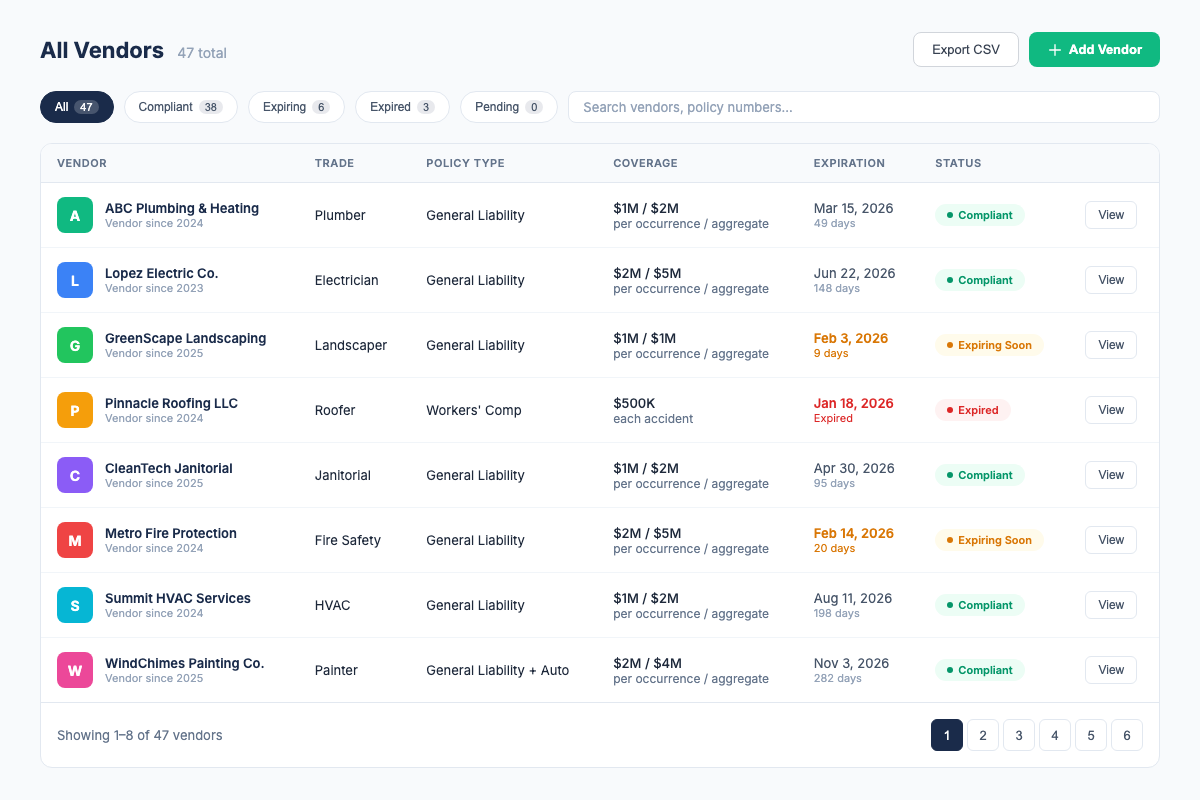
- Expiration tracking. COI File tracks the vendor certificate expiration date and reminds you at 30, 14, and 7 days so you can request an update.
- Vendor magic link. Give vendors a secure upload link for a replacement PDF without requiring an account.
- CSV roster export. Export current vendor and review status data for internal follow-up or sharing.
COI File starts with a 7-day trial after secure checkout and payment-method setup. Start a Base trial and stop relying on assumptions about who is actually covered.
Frequently Asked Questions
Sources & References
- IRMI, Additional Insured Endorsements, Comprehensive analysis of ISO additional insured endorsement forms, coverage scope, and risk transfer implications. irmi.com
- ACORD, Certificate of Insurance Standards, Official ACORD 25 form specifications, issuance guidelines, and the legal limitations of certificates versus policies. acord.org
- NAIC, Certificate of Insurance Model Act, Model legislation governing the use and regulation of certificates of insurance across U.S. states. content.naic.org
- Gilbane Building Co. v. St. Paul Fire & Marine Ins. Co., New York Court of Appeals ruling (2018) on the limits of blanket additional insured endorsements and privity of contract. nycourts.gov
- ISO, Commercial General Liability Forms, Standardized insurance policy forms and endorsement language. verisk.com/insurance
Related Resources
- Certificate of Insurance, Complete Guide, what a COI is, how to read an ACORD 25 form, and who needs one
- How to Verify a Certificate of Insurance, systematic verification checklist to catch errors, omissions, and fraud
- ACORD 25 Form Guide, line-by-line breakdown of the standard certificate of liability insurance
- COI Requirements Guide, minimum insurance requirements by industry and vendor type
- COI Tracking, Complete Guide, how to automate vendor compliance tracking
- COI File Features, see how our platform handles additional insured verification
Firdaosh Bano
COI Compliance Specialist
Firdaosh Bano is a COI compliance specialist and the founder of COI File. She spent 6 years managing vendor compliance for commercial properties - tracking 2,000+ COIs across 150+ properties in spreadsheets before building the tool she wished she'd had. She writes about certificate of insurance compliance, vendor risk management, and making insurance tracking less painful for small teams.